Sky Force Reloaded
- 4.2
- Rating
- 10.00M
- Installs
- Free
- Price
 Analysis by App-foxy
Sky Force Reloaded is the kind of arcade game I can open for a short break and still find myself playing much longer than planned. It puts me in control of a small aircraft, sends me through enemy-filled stages, and asks me to balance shooting, movement, rescue objectives, upgrades, and survival. That combination makes it more than a simple reaction test: each run is also a small decision about risk, patience, and how I want to improve my aircraft.
After spending time with it, I see why this Android and iOS game has reached more than 10 million installs and an average rating of 4.2 from around 217,000 ratings. It is free to start, suitable for Everyone, and developed by Infinite Dreams. The presentation is approachable, but the later challenge is much less casual than the bright visuals suggest. If you enjoy classic shoot ’em ups with modern progression, it is an easy recommendation. If you want a completely relaxed game with no repeated attempts or upgrade planning, it may test your patience.
How the current version feels to play
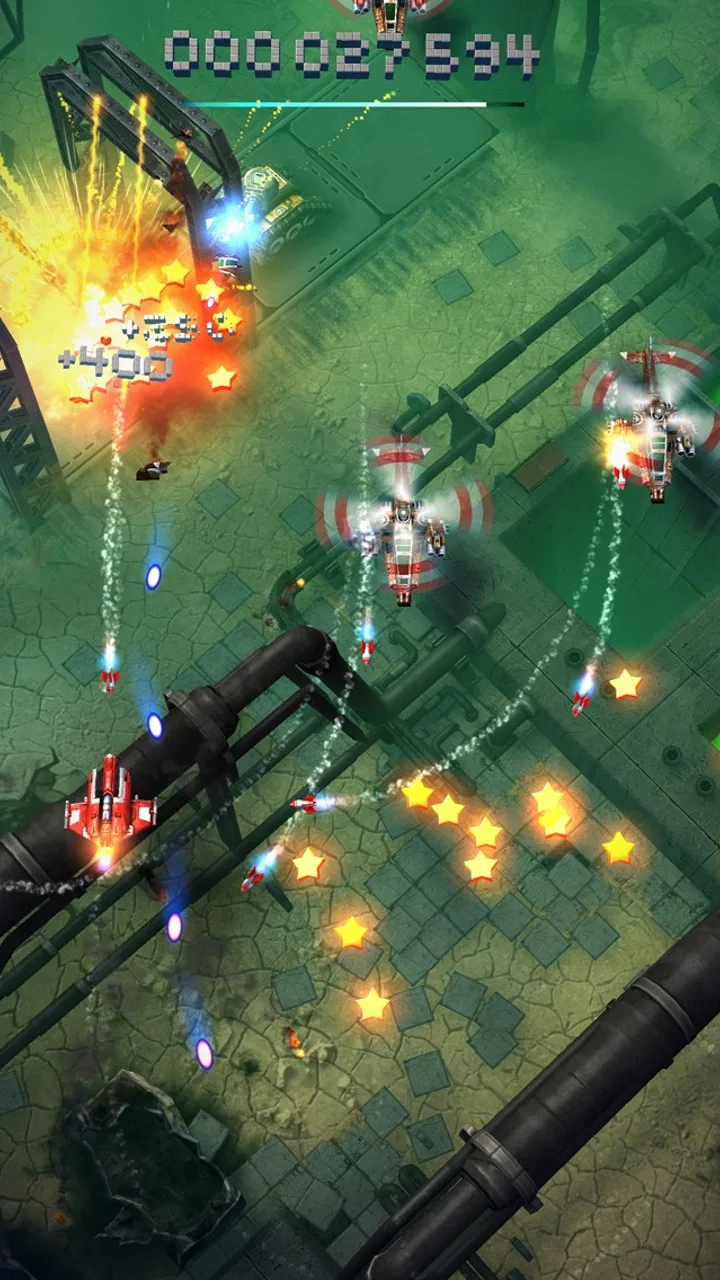
The central action is immediately understandable. My plane moves around the screen while enemies, projectiles, obstacles, and targets arrive from above. I can concentrate on staying alive and firing, but the best results come from reading the entire playfield rather than staring only at the next enemy. A safe-looking route can close quickly when several attacks overlap, so movement has to be deliberate instead of frantic.
You May Also Like

 Blood Strike: 2.5 Anniversary
Blood Strike’s Loadouts Turn Every Drop Into a Tactical Gamble
A close look at Blood Strike’s custom loadouts: how fast access to signature weapons reshapes its battle royale rhythm, rewards preparation, and narrows the gap between fights.

 Pandora - Music & Podcasts
Pandora’s Music Is Easy to Start, but Harder to Recover
Pandora’s strength is its low-effort path from a seed to a station. Its weak spot is how much confidence it asks you to place in connection, setup, and quiet recovery.

 8 Ball Pool
 Is Built on Rivalries, Rematches, and Routine
A close look at the rivalries, rematches, shared routines, and unanswered safety questions that turn a quick pool match into a persistent mobile community.

 Samsung Music
’s Quiet Strength Is Playing What You Already Own
Its reach comes less from spectacle than from dependable access to a personal library. That simplicity is both the app’s strongest retention engine and its ceiling.

 AccuWeather: Weather Radar
AccuWeather Review: A Quick, Clear Forecast for Everyday Decisions
For everyday plans, the best forecast is the one you can understand quickly. AccuWeather makes rain timing, radar, and local conditions easy to act on, with a few trade-offs.

 Hill Climb Racing
Why Hill Climb Racing Still Turns Crashes Into One More Run
A tiny car, a bumpy hill and one more upgrade: Hill Climb Racing keeps resurfacing because its simple chaos makes every near-miss feel personal.
More From Our News Desk



The controls are designed for touch, and that matters because this genre depends on quick positioning. I found the game most comfortable when I kept my finger movements smooth and avoided making large corrections at the last moment. Dragging too aggressively can save me from one projectile while placing the aircraft directly into another. The useful habit is to move early, leave myself an escape route, and treat the edges of the screen as temporary tools rather than permanent safe zones.
Stages are built around more than simply reaching the end. Rescuing people, collecting useful items, destroying selected targets, and completing other objectives give each attempt a different focus. I often began a level intending to clear it safely, then noticed an optional target and changed my route. That is where the game becomes interesting: chasing every reward can improve progress, but it also exposes the aircraft to attacks I could have avoided.
The most important skill is not firing faster; it is deciding what to ignore. New players often try to collect everything visible and then blame the controls when the screen becomes overwhelming. I had better results by identifying the safest path first, then taking an optional reward only when the surrounding attack pattern allowed it. This small change makes the game feel fairer and gives improvement a clear, practical shape.
Progression that gives repeated runs a purpose
Finishing a stage is only part of the experience. The aircraft can be improved, and those upgrades change how I approach later attempts. A stronger plane does not remove the need for good movement, but it can make earlier mistakes less punishing and help me reach sections that previously felt out of reach. The progression therefore works best as a reason to replay rather than as a replacement for skill.
I recommend upgrading with a plan instead of spreading resources across every available improvement. If I was struggling to survive, defensive improvements offered more value than chasing a small increase in damage. When a stage felt manageable but took too long to clear, offensive development made more sense. This is a useful trade-off because it lets players respond to a specific weakness rather than blindly following a single upgrade path.
That approach also answers a common concern: can someone enjoy the game without paying? The game is free, and I could make meaningful progress by replaying stages and improving my performance. Optional purchases range from $1.99 to $7.49 per item, so players should understand that monetization is present. I would not install it expecting a completely purchase-free arcade experience, but I also would not describe spending as the only way to make progress.
The bigger cost for a free player is time and repetition. Some upgrades become easier to appreciate after several attempts, and repeating a stage can feel slow if I am trying to advance quickly. For me, that is acceptable because each replay gives a concrete goal: rescue more people, collect more rewards, avoid damage, or reach the next improvement. Someone who dislikes repeating content may find the progression less satisfying.
Why the arcade design still works on a phone
Many mobile shoot ’em ups become cluttered with menus, timers, or complicated systems. This one keeps the basic loop visible: enter a stage, survive its patterns, complete objectives, and use the results to prepare for another attempt. The colorful aircraft and enemies make the action easy to read, while the increasing pressure gives experienced players something to master.
I especially like that a short session can still feel productive. If I have only a few minutes, I can attempt a familiar stage and work on one objective rather than needing a long uninterrupted campaign session. On a quiet evening, I can take more time to learn enemy placement and improve my route. That flexibility makes it a good fit for commuting, waiting rooms, or a quick break, provided the player is comfortable with the possibility that “one more attempt” will extend the session.
The game also suits players who enjoy visible mastery. The first successful clear is not necessarily the best result. There are reasons to return, and the difference between surviving by luck and controlling the stage deliberately becomes noticeable. I started paying attention to when enemies entered the screen, where projectiles left gaps, and which targets were worth approaching. Those observations are more rewarding than simply raising a number in a menu.
What feels different from simpler alternatives
Compared with a basic endless shooter, this game gives my sessions more structure. An endless format can be excellent for chasing a high score, but it may feel repetitive when I want a clear objective. Here, stage-based progression gives me a reason to try again after failure. I know what I am working toward, even when the immediate goal is simply surviving a difficult section.
Compared with slower puzzle-oriented arcade games, the appeal is almost the opposite. There is little time to stop and calculate every move once the screen fills with threats. The game rewards quick recognition and practiced routes. I would choose it over a puzzle game when I want active concentration, but I would choose the puzzle alternative when I am tired and do not want to react under pressure.
It also differs from a purely retro shoot ’em up that offers a fixed challenge with little progression. The upgrade system makes failure less final, because a difficult attempt can still contribute to a stronger future run. The trade-off is that the experience is not as clean or self-contained as a traditional arcade cabinet. Players who prefer a single skill test without progression layers may find the modern structure less appealing.
Changes, compatibility, and the experience for returning players
The current version is 2.06, and the game was released on June 1, 2016. That history is useful context: this is an established mobile title rather than a brand-new experiment. I would approach it as a mature arcade game whose core identity is already settled. The release age also means returning players should judge it by how well its established loop works today, not by expecting a completely different game from a recent launch.
It supports devices running Android 7.0 or later, which makes it accessible to many players using older hardware. Compatibility alone does not guarantee identical comfort on every phone, though. Touch response, screen size, and how easily a finger covers part of the action can affect a precision-heavy game. Before committing to long sessions, I would test whether the controls feel accurate on the particular device being used.
For an existing player, the most meaningful evolution is not something I would assume from a version label alone. The practical question is whether the current build still delivers stable stage progression, responsive controls, and a fair relationship between skill and upgrades. In my experience, those are the areas that determine whether a long-running arcade game remains enjoyable. I would update normally, then judge the result through actual play rather than expecting a dramatic redesign.
New players should also know that the game does not become instantly easy just because the opening stages are approachable. The early portion teaches the basic rhythm, but later success depends on remembering patterns and making better choices about optional objectives. Returning players who already know the routes will naturally have an advantage, while newcomers may need several attempts before the game’s visual language becomes readable.
One useful way to start is to treat the first sessions as training rather than as a test of final ability. I focused on staying alive and learning movement before chasing every collectible or side objective. Once I understood where danger usually arrived from, I could add optional goals without turning each attempt into chaos. This approach reduces frustration and makes the upgrade system feel connected to actual learning.
Small techniques that make a real difference
First, I avoid hugging the bottom edge continuously. It feels safe because the aircraft has more time to react to threats above, but it can also leave too little room when attacks arrive from both sides. Staying slightly higher when the route is clear gives me more space to move downward, while shifting lower only when I need to avoid a specific pattern. The best position changes constantly; there is no universal safe corner.
Second, I separate survival goals from collection goals. On a first attempt, I ask whether I can finish the section without damage. On a later attempt, I choose one optional objective and build the route around it. Trying to complete every task immediately makes it harder to tell whether failure came from poor movement or an overly ambitious route. This two-pass method is particularly helpful for players who feel that the game is unfair at first.
Third, I spend upgrade resources according to the stage that is blocking me, not according to a general idea of what sounds strongest. A defensive improvement can be more valuable than extra firepower if I am reaching the boss or final section but losing to stray hits. Conversely, damage becomes the better choice when I can survive but cannot clear threats quickly enough. This is a simple decision, but it prevents wasted progress.
Fourth, I use familiar stages as practice spaces instead of viewing them only as farming chores. I can work on smoother movement, safer collection routes, or avoiding a particular attack while still earning progress. That turns repetition into focused practice. It also helps me decide whether I genuinely enjoy the game’s loop, because the long-term experience depends on being willing to revisit content.
Where the game may frustrate you
The strongest limitation is repetition. The same stage-based structure that gives the game purpose can become tiring when progress demands several attempts. I enjoyed replaying levels while I had a clear improvement target, but the process felt less appealing when I was repeating a section mainly to gather enough resources. Players seeking constant novelty should keep this in mind.
The touch interface is another potential obstacle. Precise movement on a small screen is never identical to using physical controls, and a finger can obscure the aircraft or nearby hazards. I adapted by making smaller movements and watching the space ahead of the plane, but players who strongly prefer a controller may not find the touchscreen experience ideal.
The free-to-play structure also deserves a realistic warning. Even when purchases are optional, their presence can change how the progression feels. Some players will appreciate having a shortcut available; others will feel that the natural pace is too slow once they understand the alternatives. I would recommend trying the free experience first and deciding whether the repetition feels enjoyable before spending anything.
This is not the right choice for someone who wants a calm, story-led adventure, a one-handed game with almost no concentration, or a short campaign that ends cleanly. It is also a poor fit if repeated attempts feel like wasted time rather than practice. I would point those players toward a slower arcade game or a fixed premium experience instead. Sky Force Reloaded is at its best when the player enjoys learning patterns and improving through small, measurable changes.
Who should try it now
I think it is especially suitable for fans of classic vertical shoot ’em ups who want a mobile-friendly progression system. It also works for players who enjoy games that are easy to understand but difficult to perfect. The Everyone content rating makes it broadly approachable, although the intensity of the action may still be more important than the age label for very young or easily frustrated players.
It is a good choice for a person who likes having several session lengths available. A quick attempt can fill a spare moment, while a longer session can involve replaying stages, improving the aircraft, and working toward more demanding objectives. I often used it when I wanted something more active than a puzzle but less involved than a large role-playing game.
I would be more cautious recommending it to someone who dislikes in-app purchases on principle. The game is free, but optional items priced between $1.99 and $7.49 are part of the experience. I would also warn competitive perfectionists that success may require patience rather than immediate mastery. The game can be rewarding, but it does not always provide that reward after a single attempt.
Its large audience—more than 7,000 written reviews alongside the broader rating total—suggests that the format has connected with many players, but popularity should not decide the purchase for you. The real test is whether you enjoy the loop of moving, shooting, failing, adjusting, and trying again. If that cycle sounds satisfying, the game has enough structure to remain useful beyond an initial curiosity download.
My final view after playing
Sky Force Reloaded remains a strong arcade recommendation because it combines readable action with meaningful replay. Infinite Dreams gives the game a clear identity: it is not trying to be a relaxed idle title or an endless score chase. It asks me to improve my movement, choose my risks, and invest in the aircraft in response to actual problems. That makes each successful stage feel earned.
Its weaknesses are equally clear. Repetition can wear thin, touch controls will not suit everyone, and the free-to-play model may make the pace feel less comfortable for players who want a fully self-contained experience. Those are not minor details, but they are manageable if I approach the game as a skill-based arcade challenge rather than a quick disposable download.
My recommendation is simple: try it if you want a polished-feeling mobile shoot ’em up with stages, objectives, and upgrades, and give yourself time to learn the routes before judging the difficulty. Skip it if you want constant new content, minimal repetition, or no purchase prompts. For my own use, Sky Force Reloaded works best as a repeatable short-session game that rewards careful movement more than reckless aggression.
As the current 2.06 build continues to be the version players encounter, I would watch for how future maintenance affects compatibility and the balance between free progression and optional spending. I would not expect a version number alone to change the core experience. The lasting question is whether the game continues to respect the player’s time while preserving the demanding arcade rhythm that makes it worth returning to.
FAQs for Sky Force Reloaded
01What is Sky Force Reloaded?
Sky Force Reloaded is an arcade-style vertical scrolling shooter for Android and iOS. You control a powerful aircraft through intense stages filled with enemy planes, turrets, tanks, ships, and large bosses. The game combines classic shoot ’em up action with modern graphics, upgradeable weapons, collectible stars, rescue missions, and optional objectives that encourage you to replay completed levels.
02Is Sky Force Reloaded free to download and play?
Sky Force Reloaded can generally be downloaded for free, but the mobile version may include optional in-app purchases. These purchases can provide extra resources, upgrades, or convenience, although they are not required to experience the core gameplay. Progress is mainly earned by completing missions, collecting stars, and improving your aircraft through regular play and repeated attempts.
03Does Sky Force Reloaded require an internet connection?
Many of Sky Force Reloaded’s main shooting missions can be played offline, which makes it suitable for short sessions while traveling or when mobile data is unavailable. However, certain features may depend on an internet connection, including advertisements, cloud-related services, store content, events, or promotional rewards. Availability can vary according to the platform and version installed.
04What gameplay features and upgrades are included?
The game offers more than simple nonstop shooting. You can upgrade your aircraft’s weapons, armor, missiles, and special abilities, while also collecting stars to improve your performance. Levels include different objectives, such as rescuing people, destroying specific targets, or finishing without taking damage. These challenges add variety and make replaying stages worthwhile.
05Is Sky Force Reloaded suitable for beginners?
Sky Force Reloaded is accessible for beginners because its controls are simple: move the aircraft, avoid incoming attacks, and fire continuously. Nevertheless, later stages become demanding, with dense bullet patterns, stronger enemies, and bosses requiring careful movement. Players who prefer relaxed progress can replay earlier missions to collect stars and upgrades before attempting more difficult challenges.
Pros
- Exciting arcade action with varied enemy formations and attack patterns.
- Responsive controls make aiming and dodging feel precise on mobile screens.
- Many aircraft upgrades let you customize weapons
- armor
- and special abilities.
- Short missions work well for quick gaming sessions on the go.
- Strong visual effects and energetic music make battles feel lively and rewarding.
Cons
- Later missions can become extremely difficult without repeated upgrades and practice.
- Some upgrades and retries may require significant grinding to unlock.
- The screen can become visually crowded during intense boss encounters.
- Touch controls may feel less comfortable than using a physical controller.
- Progression and extra content can be affected by optional in-app purchases.

Sky Force Reloaded
Gallery